
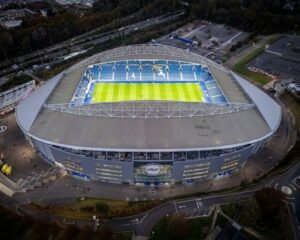
 In a development that could redefine sporting infrastructure in the South of England, Brighton & Hove Albion has reportedly approved a $780.3 million (£630 million) investment package to undertake one of the most ambitious stadium transformation projects seen in the Premier League outside of London and the North-West. Although full official press releases from the club and local council are still awaited, multiple industry sources and planning indicators suggest that approval has been granted and that major contractual agreements have now been signed to begin construction in 2026.
This bold plan represents a dramatic escalation of investment compared with the club’s ongoing incremental upgrades at the home of Albion’s footballing journey, the American Express Stadium — officially known as Falmer Stadium since its opening in 2011.
—
A New Era for the American Express Stadium
The American Express Stadium (Amex) has been the spiritual and strategic heart of Brighton & Hove Albion’s rise from lower-league status into a respected Premier League mainstay. Built at a cost of around £93 million and opened in July 2011, it has been a central piece in the club’s identity.
Under this new plan, the stadium is set for a comprehensive overhaul that goes far beyond the piecemeal enhancements seen in recent years — such as expanded safe standing sections, enhanced fan zones, and hospitality suites — to something more transformative and future-proof.
The $780.3 million project is reported to include:
Major expansion of seating capacity — potentially pushing the stadium towards a 40,000+ capacity, a significant leap from its current ≈31,876 seats.
Redesigned West and South Stands to house expanded premium hospitality, corporate lounges, broadcast facilities, and modern supporters’ terraces.
Multi-use community and event facilities that could allow the stadium to host concerts, conferences, and international sporting events.
Enhanced transport and accessibility, with upgraded pedestrian, coach and parking infrastructure around Village Way and the surrounding precinct.
Integration of training, performance, and women’s football facilities, reflecting the club’s commitment to building infrastructure for both men’s and women’s teams and community football initiatives.
Sources familiar with the plans have indicated that the ambition extends to world-class supporter experience, not just increased capacity — including digital engagement technologies, improved accessibility for disabled fans, and hospitality experiences that reflect global best practices.
—
Strategic Alignment With Club Vision
For club leadership, led by chairman Tony Bloom and chief executive Paul Barber, the stadium project is more than bricks and mortar: it is a cornerstone of the long-term competitive and commercial strategy.
Barber has previously outlined Brighton’s vision of on-field success matched by off-field infrastructure that is among the best in English football. Incremental improvements such as “The Terrace” fan zone and expanded club superstore are part of a broader philosophy of blending matchday tradition with progressive design and multi-purpose functionality.
While the figure of £40 million invested in previous Amex projects already hinted at the club’s appetite for evolution, this new $780.3 million plan signals a much more profound commitment. The goal appears to be to elevate the Amex from an efficient modern stadium to a globally-recognised sporting venue capable of hosting a wide range of high-profile events in addition to Premier League football.
—
Contract Awards and Construction Partners
While the club has not publicly confirmed the contractors, football infrastructure analysts point to talks with leading stadium builders as part of preliminary negotiations. Globally experienced architects and engineering firms with portfolios of major stadium builds are thought to be in advanced contact with the club. Reports suggest the contract structure might be phased:
1. Phase 1: Structural Expansion & Seating Works — Capacity extension and foundation strengthening.
2. Phase 2: Hospitality, Media & Commercial Areas — Premium lounges, broadcast spaces, and fan experiences.
3. Phase 3: Community & Multi-Use Facilities — Club museum, education and community sports hubs, women’s football home ground provisions.
Phased contracts are common in complex stadium redevelopments to ensure continuous operation during construction and minimize disruption to match schedules.
—
Economic and Community Impact
Approval of a project this scale carries significant economic implications for the city of Brighton & Hove and the wider Sussex region.
Local Economy and Jobs
Construction alone is expected to generate thousands of jobs over several years — from architectural work and engineering to hospitality and stadium operations. Beyond construction, the expanded stadium will bring increased footfall on matchdays and more non-matchday events such as concerts, conferences, and cultural activities.
Sporting Legacy and Participation
Brighton & Hove Albion’s commitment to community and grassroots football is well documented. A major stadium upgrade also enhances community access to world-class sporting facilities. Plans reportedly include:
Space for youth and academy development programmes.
Training facilities aligned with elite performance standards.
Dedicated areas for women’s football teams, reflecting growth in the Women’s Super League.
These elements are crucial not just from a sporting perspective, but also in terms of community identity and youth engagement.
—
Navigating Challenges and Skepticism
As with any project of this magnitude, there will be challenges ahead. Local councils must finalize planning permissions, environmental assessments, and transport impact studies — all of which require extensive public consultation and statutory approvals.
Residents and supporters may have questions about noise, traffic, and the broader impact on the area surrounding the stadium precinct. Experience from other large-scale developments shows that transparent engagement and robust mitigation strategies are essential in maintaining community support.
—
What Comes Next?
If the reported $780.3 million investment and contract signings are indeed confirmed, 2026 will mark the beginning of a new architectural and cultural chapter for Brighton & Hove Albion. With construction expected to begin later in the year following final planning approvals, fans and city residents will be watching closely as one of England’s most forward-thinking clubs embarks on this ambitious journey.
The year ahead promises official club statements, planning documents, and detailed architectural designs — each shedding more light on how the Amex Stadium may look in the mid-2030s and how this iconic venue could become a fixture not only of the Premier League calendar but of international sport and entertainment events as well.
Leave a Reply