
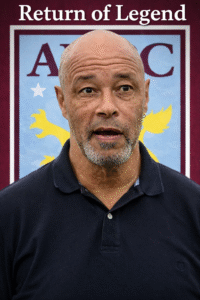
 In a moment that has sent shockwaves of joy through the heart of the Midlands and across the wider English football community, Aston Villa FC head coach Unai Emery has officially confirmed that club legend Paul McGrath is returning to the organisation — not as a player this time, but as a newly appointed senior coach.
For Villa supporters, this announcement feels less like a routine staffing update and more like a long-awaited homecoming. McGrath is not just another former player; he is woven into the club’s modern mythology. His return signals continuity between the glorious past and a future that looks increasingly ambitious under Emery’s stewardship.
—
A Legend Comes Home
Paul McGrath’s name still carries immense weight at Villa Park. Signed from Manchester United in 1989, the Irish defender quickly established himself as one of the most gifted and courageous centre-backs in English football. Despite battling chronic knee problems that would have ended most careers, McGrath produced performances of astonishing consistency and class.
His crowning achievement came in the 1989–90 season, when he was voted PFA Players’ Player of the Year — a rare honour for a defender and one that cemented his legacy. To this day, many Villa fans still describe him as the greatest defender ever to wear the claret and blue.
Now, more than three decades after his arrival as a player, McGrath’s return as a senior coach represents a powerful emotional and symbolic moment for the club.
—
Emery’s Vision: Blending History with Modern Football
Unai Emery has built a reputation as a coach who respects footballing heritage while relentlessly pursuing tactical evolution. Since arriving at Aston Villa, he has overseen a transformation in mentality, structure, and ambition.
Speaking at the official announcement, Emery praised McGrath not only for his legendary status but also for the unique qualities he brings as a mentor:
> “Paul understands this club in his bones. He represents resilience, professionalism, and excellence. Our players will benefit enormously from his experience and his mentality.”
Emery’s decision to appoint McGrath is not rooted in nostalgia alone. It reflects a broader philosophy: to surround the squad with figures who embody Villa’s identity while maintaining modern coaching standards.
—
What Will McGrath’s Role Be?
As senior coach, McGrath is expected to work closely with the defensive unit, offering guidance on positioning, composure, and leadership — areas in which he excelled as a player. However, insiders suggest his influence will extend beyond the back line.
He is likely to play a mentoring role for younger players, helping them cope with the pressures of top-flight football and instilling the discipline required at elite level. His life story — overcoming injury, personal struggles, and immense pressure — gives him a credibility few can match.
In many ways, McGrath becomes a bridge between generations: a living reminder of Villa’s proud traditions and a practical guide for players seeking to write their own chapter in the club’s history.
—
Fans React: “This Feels Like Destiny”
Social media erupted within minutes of the announcement. Phrases like “welcome home, legend” and “this is what football is about” flooded timelines. For older supporters, McGrath’s return stirs memories of packed terraces and heroic defensive displays. For younger fans, it offers a tangible link to stories they have grown up hearing.
Supporters’ groups described the move as “a masterstroke” and “a sign that Villa truly understands its identity again.” Many believe McGrath’s presence will help create a stronger emotional bond between players and fans — something that can prove decisive during difficult moments in a season.
—
The Wider Impact on the Premier League
The return of iconic former players to coaching roles has become a growing trend across the Premier League, but McGrath’s case feels particularly poignant. Unlike some legends who drift into media work or ambassadorial roles, he is stepping directly into the competitive heart of the club.
This move reinforces Aston Villa’s reputation as a club serious about long-term development rather than short-term fixes. It also sends a message to rivals: Villa are not just building a squad; they are building a culture.
—
A Story of Redemption and Purpose
McGrath’s life after football has been as complex as his playing career was brilliant. He has spoken openly about his struggles with addiction and the challenges of life beyond the pitch. His journey of recovery and self-reflection has earned widespread respect, and his willingness to share those experiences adds depth to his coaching credentials.
For many, his return is not just a footballing story but a human one — a tale of redemption, belonging, and second chances. It underlines the idea that football clubs are more than institutions; they are communities that can heal and reconnect.
—
Tactical Benefits: A Defender’s Brain in the Dugout
From a footballing perspective, McGrath’s understanding of defensive structure will be invaluable. Modern football demands defenders who are comfortable in possession, tactically intelligent, and emotionally disciplined. McGrath embodied all three traits in an era far less forgiving of technical errors.
Working alongside Emery’s highly detailed tactical framework, McGrath can help translate theory into instinct — showing defenders how to read the game rather than simply react to it. This could be especially crucial as Villa aim to compete consistently against elite opposition both domestically and in Europe.
—
What This Means for Aston Villa’s Future
The appointment of Paul McGrath is more than symbolic. It represents a strategic move to root Aston Villa’s future in its past while embracing modern football realities.
With Emery steering the technical direction and McGrath reinforcing the club’s values, Villa appear to be constructing a structure that blends ambition with identity. For players, it offers clarity. For fans, it offers hope. And for the club as a whole, it signals a renewed commitment to excellence built on tradition.
—
“The Best News We Could Hope For”
The headline may sound dramatic, but few would argue with its sentiment. Football is at its most powerful when it connects generations — when heroes of the past return to shape the dreams of the present.
Paul McGrath walking back into Aston Villa, this time in a coaching role, feels like a storybook moment. Yet it is also grounded in practical logic: his knowledge, experience, and emotional connection to the club make him uniquely suited to the task.
As Aston Villa look toward a future filled with promise, this reunion stands as a reminder that progress does not mean forgetting where you came from. Sometimes, the best way forward is to welcome home the people who helped define who you are.
Leave a Reply