
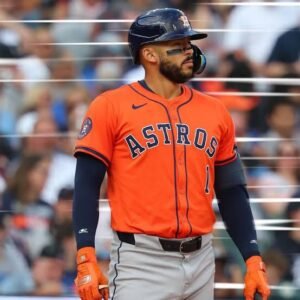
 For a player of Correa’s stature — a former No. 1 overall draft pick, World Series champion, and perennial All-Star — any association with performance-enhancing drugs carries enormous consequences. Whether proven or disproven, the story has already reopened long-standing debates about integrity, fairness, and transparency in modern professional sports.
A Star Under the Microscope
Carlos Correa has long been regarded as one of the premier shortstops in the game. Since entering the league as a highly touted prospect, he has built a reputation not only for his defensive excellence but also for his clutch hitting and leadership presence in the clubhouse. To many Houston fans, Correa represents the modern face of the franchise — talented, confident, and fiercely competitive.
That is precisely why the rumors surrounding a failed drug test landed with such force. High-profile athletes live under constant scrutiny, and even unconfirmed allegations can reshape public perception overnight. For Correa, whose career has already been shaped by injuries and the Astros’ past controversies, the emergence of this report adds another layer of complexity to an already intense spotlight.
What the Reports Claim
According to early online sources, Correa allegedly returned an adverse analytical finding during a routine drug screening conducted under MLB’s Joint Drug Prevention and Treatment Program. No specific substance has been named, and neither the league nor the players’ union has verified the authenticity of the claim.
In similar cases across professional sports, the standard procedure involves:
1. A confidential notification to the player.
2. A secondary confirmation test.
3. A formal disciplinary review.
4. An official announcement only after the appeals process concludes.
Until that process is completed, any claim of suspension remains speculative.
Silence From Official Channels
As of now, MLB officials have declined to comment, citing privacy rules within the league’s drug-testing policy. The Astros organization has also released no formal statement, while Correa himself has not addressed the rumor directly on social media.
This silence, while procedural, has done little to slow speculation. In the age of instant news, the absence of information often creates more noise rather than less. Fans and analysts alike have begun dissecting Correa’s recent performances, searching for patterns or signs that could support or contradict the claim.
Fan Reaction: From Shock to Skepticism
Astros fans responded with a mixture of disbelief and defensive loyalty. Many took to online platforms insisting the reports were false or exaggerated, emphasizing Correa’s professionalism and dedication to training.
Others adopted a wait-and-see approach, urging caution until official confirmation emerges. “We’ve seen careers damaged by rumors before,” one fan wrote. “Until MLB says something, this is just talk.”
Opposing fan bases, however, were less forgiving. Some revived old grievances tied to Houston’s past controversies, arguing that the organization’s history makes any new allegation harder to ignore.
The Weight of History in Baseball
Drug scandals have long haunted baseball. From the steroid era of the late 1990s and early 2000s to more recent suspensions, the sport has struggled to reconcile its pursuit of power and performance with the need for integrity.
The league’s drug policy today is far stricter than it once was. Random testing, biological passports, and lengthy suspensions are now standard practice. A first offense can result in an 80-game suspension, while repeat violations can end careers entirely.
That reality makes any rumor involving a superstar particularly jarring. A confirmed suspension would not only sideline Correa but would significantly alter the Astros’ competitive outlook for the season.
Impact on the Houston Astros
From a purely baseball perspective, Correa’s absence would leave a major void in Houston’s lineup and defensive structure. He is more than a shortstop; he is a central figure in the team’s identity and leadership.
Losing him — even temporarily — would force the Astros to reshuffle their infield and rely on less experienced players in critical moments. In a league where playoff races are often decided by slim margins, the loss of a star player can be the difference between October glory and early elimination.
Beyond the field, there is the commercial and reputational impact. Jerseys, endorsements, and sponsorships tied to Correa could be affected, depending on how the situation unfolds.
The Player’s Perspective
If the reports are true, Correa would be entitled to appeal and request a re-test. Athletes have, in the past, successfully challenged positive results by pointing to contaminated supplements or procedural errors.
If the reports are false, the damage to his image could still linger. Public memory is short, but digital records are permanent. Even disproven accusations can follow an athlete for years, reshaping how achievements are viewed.
In either scenario, Correa faces a difficult road — one that will require transparency, patience, and careful legal navigation.
Media Responsibility and the Danger of Premature Headlines
This situation also raises serious questions about sports journalism in the digital age. The rush to be first often comes at the expense of being accurate. When an athlete’s name trends alongside words like “banned” and “positive test,” the psychological and professional consequences can be severe.
Responsible reporting demands verification, not amplification of rumor. Until official sources confirm disciplinary action, headlines should reflect uncertainty rather than certainty.
What Happens Next?
The next steps are clear but uncertain in timing:
MLB will either confirm or deny the reports.
If a positive test exists, disciplinary proceedings will follow.
Correa and his representatives may release a statement.
The Astros may address the situation publicly.
Until then, the baseball world remains in suspense.
A Moment That Tests Trust in the Game
Whether this story ends in exoneration or suspension, it underscores a larger truth: modern sports are as much about credibility as competition. Fans invest emotionally in athletes, seeing them as symbols of effort and excellence. When that trust is shaken, even temporarily, the entire sport feels the impact.
For Carlos Correa, this moment could become a defining chapter — either as a reminder of how fragile reputations can be or as the beginning of a long and difficult rehabilitation of public trust.
Conclusion
The headline “TOUCH DOWN” may suggest finality, but in reality, this story is still unfolding. Without confirmation from Major League Baseball or the Houston Astros, the alleged positive test remains just that — an allegation.
Yet the reaction alone shows how powerful such claims can be. In a league shaped by both legendary triumphs and infamous scandals, the truth matters more than ever.
For now, the baseball community waits — not for drama, but for clarity.
Leave a Reply