
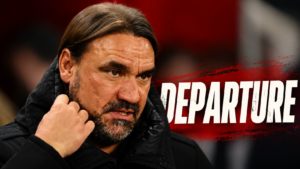
Leeds United supporters were left stunned and emotional following a heartbreaking announcement that sent shockwaves throughout the football community. In this fictional scenario, General Manager Daniel Farke officially confirmed that he would be stepping away from his position at the club due to unforeseen personal circumstances that, according to sources close to the situation, had become impossible for him to ignore.
The announcement came during what had otherwise been viewed as a period of renewed optimism for Leeds United. After months of strategic planning, rebuilding, and preparing the club for future challenges, few could have predicted such an abrupt turn of events.
Speaking at a specially arranged press conference held at the club’s training complex, Farke appeared visibly emotional as he addressed journalists, club staff, and supporters who had gathered in anticipation of important updates regarding the team’s future.
“These have been some of the most rewarding years of my professional life,” he said in this fictional account. “Leeds United is a special football club with extraordinary supporters. However, after careful consideration and numerous discussions with my family, I have decided that stepping away from my role is the right decision at this time.”
His statement was met with stunned silence before waves of appreciation poured in from fans across social media platforms. Many expressed gratitude for his dedication and commitment to the club, while others struggled to come to terms with the possibility of moving forward without one of the individuals who had become synonymous with the club’s recent ambitions.
According to the fictional narrative surrounding his departure, Farke had been dealing with mounting personal responsibilities away from football. Those close to him described the decision as one born not out of dissatisfaction with the club but from the realization that certain aspects of life require greater attention than professional commitments.
Within hours of the announcement, tributes from former players, colleagues, and football personalities began to emerge. Messages praising his professionalism, leadership qualities, and unwavering work ethic flooded online spaces dedicated to Leeds United supporters.
Club captain figures within the fictional storyline were said to have gathered privately with Farke following the announcement to thank him for the guidance and encouragement he had provided throughout challenging periods.
One senior player reportedly stated, “He always treated everyone with respect. He demanded excellence but never forgot the importance of humanity. That is something we will carry with us.”
Throughout his time at Leeds United in this imagined scenario, Farke was credited with helping stabilize operations behind the scenes while fostering an environment built upon trust and accountability. His strategic outlook and measured approach were often highlighted as key factors in navigating difficult moments.
Supporters fondly recalled his accessibility and willingness to engage with fan concerns. Whether discussing recruitment philosophies or broader objectives for the club, he consistently emphasized the importance of unity between players, staff, and the fanbase.
As news of his departure spread beyond England, football observers from across Europe weighed in on the significance of the development. Pundits noted that leaders capable of balancing ambition with compassion are increasingly valuable within the modern game.
Some described the fictional resignation as a reminder that individuals working within elite sport often face immense pressures that remain hidden from public view. Behind the headlines and results lie personal lives shaped by responsibilities, sacrifices, and emotional challenges.
Leeds United issued an official statement expressing gratitude for Farke’s contributions.
“Daniel has served this club with integrity, professionalism, and dedication,” the statement read within this fictional account. “While we are saddened by his decision, we respect his wishes and fully support him during this period. His impact on Leeds United will not be forgotten.”
The statement further confirmed that transitional plans had already begun, with senior executives working to ensure continuity in ongoing projects and preparations.
Among supporters, reactions varied from sadness to admiration.
“I didn’t expect to wake up to this news,” one fan commented online. “If this is truly what he needs to do for himself and his family, then we have to respect it.”
Another supporter wrote, “Football is important, but people matter more. Thank you for everything.”
Outside Elland Road, several fans were imagined leaving handwritten messages of appreciation. Some carried scarves and shirts bearing signatures obtained during previous club events, symbols of memories created during Farke’s association with Leeds United.
Football historians often speak about leadership in terms of trophies and statistics. Yet in this fictional account, the measure of Farke’s influence appeared rooted in something deeper: the relationships he built and the culture he helped shape.
Former colleagues described him as meticulous in preparation and calm under pressure. Meetings that could have become tense were instead characterized by thoughtful discussions and collaborative problem-solving.
“He listened,” one fictional former associate recalled. “That sounds simple, but in football it is a rare quality.”
Speculation regarding potential successors inevitably intensified following the announcement. Analysts debated what characteristics Leeds United should prioritize in identifying a replacement capable of continuing existing projects while introducing fresh perspectives.
However, many supporters urged patience, emphasizing that the immediate focus should remain on acknowledging Farke’s service rather than accelerating discussions about the future.
As days passed, additional details emerged within the fictional narrative suggesting that the decision had not been made lightly. Sources claimed that Farke had spent weeks reflecting on his options, consulting trusted advisors, and weighing the consequences of stepping away.
Ultimately, the conclusion reached was one centered upon personal wellbeing and family priorities.
Such moments often force football communities to confront broader questions regarding expectations placed upon those operating within high-pressure environments. Success is frequently defined through outcomes visible on scoreboards and league tables, yet the human stories unfolding behind the scenes are equally significant.
For Leeds United, the challenge moving forward would involve preserving momentum while adapting to change. For Farke, a new chapter awaited—one marked not by tactical discussions or transfer negotiations but by the opportunity to focus upon matters closer to home.
In his closing remarks during the fictional press conference, he addressed supporters directly.
“From the bottom of my heart, thank you. Your passion, loyalty, and belief have inspired everyone connected with this club. Leeds United will always occupy a special place in my life.”
Those words resonated deeply among fans.
Across online forums, supporters shared photographs, memories, and messages recounting moments that defined Farke’s tenure. Some reflected upon difficult periods navigated together, while others highlighted occasions that restored optimism.
Even rival supporters acknowledged the dignity with which the fictional departure had been handled.
Sports psychologists observing situations like these often emphasize the importance of recognizing emotional realities within professional environments. Leadership positions can create immense burdens, particularly when individuals feel responsible for outcomes affecting entire communities.
Within this imagined scenario, Farke’s choice to prioritize personal circumstances represented not weakness but courage—the willingness to acknowledge limitations and act in accordance with values extending beyond professional achievement.
As preparations continued for upcoming fixtures and operational decisions, one sentiment united the Leeds United fanbase: gratitude.
Gratitude for the commitment demonstrated throughout his time at the club.
Gratitude for the professionalism displayed during challenging periods.
And gratitude for the honesty reflected in his farewell.
No departure is easy, especially when it involves figures who have become integral to an institution’s identity. Yet football, like life itself, is defined by transitions.
New leaders emerge.
Fresh chapters begin.
Communities adapt.
In the hearts of many supporters within this fictional story, Daniel Farke’s contributions would endure long after official responsibilities concluded.
The echoes of his leadership would remain present in the standards established, the relationships nurtured, and the belief instilled among those fortunate enough to work alongside him.
While uncertainty surrounded the road ahead, hope persisted.
Leeds United had weathered adversity before.
It would do so again.
And somewhere beyond the demands of football, a man who had devoted himself to the game would embark upon a different journey—one shaped by family, reflection, and the pursuit of balance.
The sadness accompanying such a farewell was undeniable.
But so too was the appreciation.
As supporters departed Elland Road following the fictional announcement, many carried a similar thought.
Sometimes the most important decisions are not measured by victories or defeats.
Sometimes they are measured by the courage to place humanity first.
For that reason, Daniel Farke’s imagined farewell would be remembered not solely as an ending, but as a powerful reminder that behind every role, title, and responsibility stands a person deserving of understanding, compassion, and support.
And as Leeds United looked toward the future, an entire fanbase stood united in offering one simple message:
Leave a Reply